 STELABEAUTYAPP
How to Choose a Foundation Shade for Your Skin Undertone
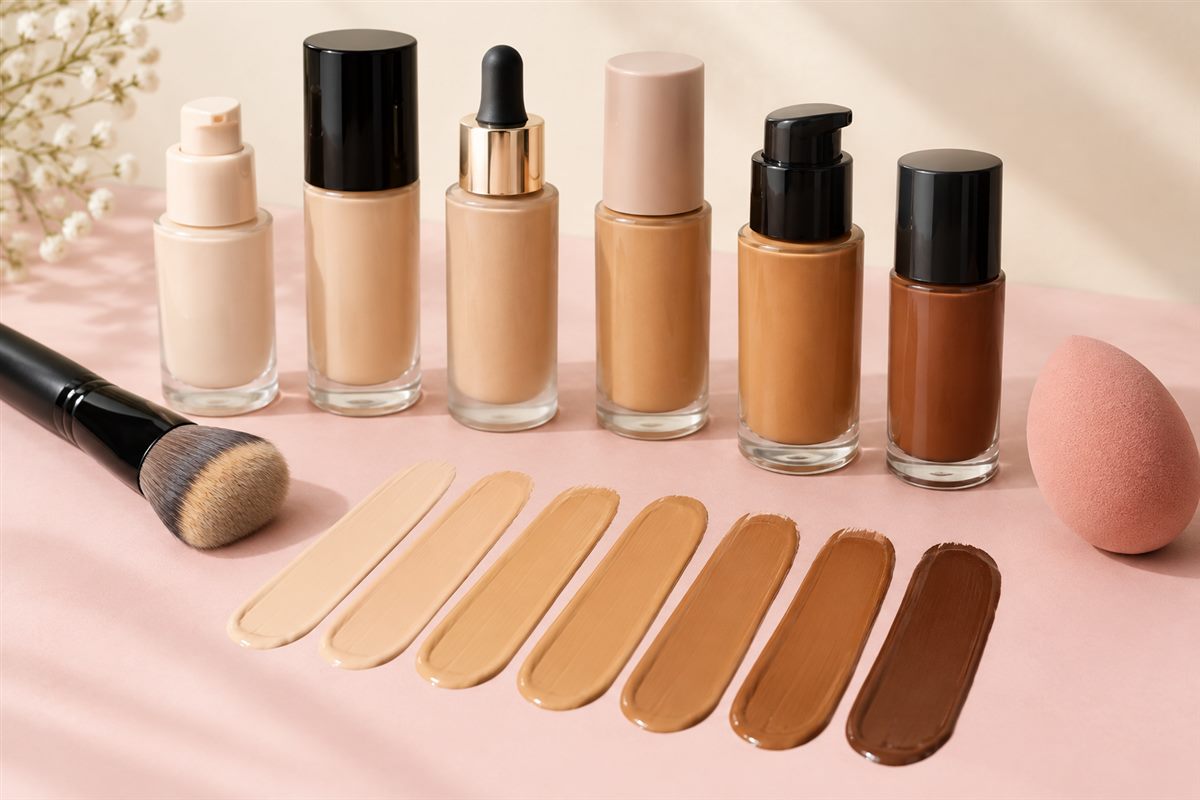
Choosing the right foundation is one of the decisions that shows most on a face: a good match blends into your skin, while a wrong one leaves a visible line along the jaw or a grayish cast in photos. The good news is that you do not have to guess. With a few simple tests you can identify your undertone, understand what product labels mean and shop with more confidence.
This guide explains the difference between shade and undertone, how to recognize yours at home, how to test a foundation in store or online, and which mistakes are worth avoiding.
Shade, intensity and undertone: three different ideas
Shade (or depth) tells you how light or deep your skin is, from very fair to very deep. Undertone is the subtle hue you perceive beneath the surface, and it does not change when you tan: it can be cool, warm or neutral. Finally, intensity, or saturation, describes how muted or vibrant the skin looks.
Two people can share the same depth and have opposite undertones. That is why a foundation that is perfect on a friend can look pink, yellow or ashy on you, even when the shade names are almost identical.
- Cool undertone: pink, red or bluish hues.
- Warm undertone: golden, yellow or peachy hues.
- Neutral undertone: a balanced mix with no clear dominance.
Three tests to find your undertone at home
No single test is definitive; the most reliable approach is to combine several and keep the result that repeats most. Do them in natural light and without makeup.
- Wrist veins: if they look bluer or purple, your undertone tends to be cool; if they look greenish, it tends to be warm; if you cannot tell the color, you may be neutral.
- Metals: notice whether silver and white gold flatter you more (cool) or yellow gold does (warm). If both look good, you are probably neutral.
- The white paper test: hold a sheet of white paper next to your face. If your skin looks pink beside it, you are usually cool; if it looks yellowish or golden, you are usually warm.
If the tests contradict each other, do not worry: many people are neutral or olive, with a soft green or golden cast. In that case, foundations labeled neutral or olive tend to work best.
Read also: How to Choose a Lipstick Color for Your Skin Tone and the Occasion.
How to test a foundation properly
Avoid testing foundation on your wrist or the back of your hand, because they are usually lighter than your face. Ideally, swipe a small stripe from your cheek to your jaw and check it in natural light, near a window.
Wait ten to fifteen minutes before deciding. Many formulas oxidize, meaning they darken slightly through contact with your skin and the air. A shade that looks perfect at first can turn more orange later.
Try two or three neighboring shades side by side. The right one is the one that disappears: you cannot see the edge, it does not change the color of your neck and it does not make your face look like a mask.
Common mistakes when choosing foundation
- Choosing a lighter shade to look more radiant. The result is usually a powdery look and a visible difference from your neck.
- Ignoring the neck and chest. If you match foundation only to your face, a border ends up showing.
- Buying by shade name alone. Every brand uses its own numbering, so compare by undertone and depth, not just the number.
- Forgetting the formula. A very matte foundation can highlight dryness, and a very luminous one can emphasize shine on oily skin.
Your shade also changes with the seasons
After summer it is normal for skin to look deeper, and in winter lighter. Some people keep two foundations and mix them to adjust the shade through the year. Undertone, on the other hand, usually stays stable, so it makes sense to keep choosing within the same family of hues.
Skin type also affects the finish. People with dry skin often prefer hydrating formulas and luminous finishes; people with oily skin often prefer natural or semi-matte finishes and lightweight primers.
Preview the result before you buy
If you shop online or do not have time to test several shades, a virtual try-on can give you an idea of how a color might look on your face. In StelaBeautyApp you can try foundation, concealer, blush, lips and eyeshadow with the live camera or a photo. Results are illustrative and may differ from the real product, so use them as a starting point and always confirm with a sample or an in-person test.
Quick summary
- Identify your undertone with several tests in natural light.
- Test foundation along the jawline, not on your wrist.
- Wait a few minutes to see whether it oxidizes.
- Match the shade to your neck, not just your face.
- Recheck your shade when the season changes.